Showing posts with label honey. Show all posts

Thursday, August 16, 2012

How Sweet It Is!

There are 20,000 kinds of bees, but up until a moment ago, I thought the European honeybee is the only one to produce honey.  Wikipedia says there are a few others that do, too.  Since Wikipedia is not the bee all, end all authority on anything, I'm sticking to the thought that honeybees are the only practical source of honey. I just returned from a COBA meeting and my bee mavens assure me that only honeybees make honey in any useful amount.

I have been getting a lot of questions about honey.  One of my South Carolina friends commented about fresh honey.  Since honey doesn't spoil, freshness  is not an issue with honey. Honey has been found in Egyptian tombs.  And yes, it was still good!

Some more important considerations than freshness are:

Know the beekeeper
You don't need to personally know the beekeeper, but it doesn't hurt.  If you know who is keeping the bees you can ask about her beekeeping philosophy.  There is a wide range of acceptable practices when it comes to beekeeping, but I prefer the ones that are free of chemicals.  Integrated Pest Management enables the beekeeper to use natural products like confectioners sugar and essential oils as well as mechanical traps to control common hive pests and fungi.  Some chemicals can't be used when there is honey to be harvested in the hive. There are certainly reputable beekeepers who correctly use chemicals to manage their hives, but unless you know your beekeeper, you won't know if these chemicals were properly handled.  

Got allergies?
Buy local honey.  It is thought that because bees pick up pollen and bring it to the hive that people with seasonal allergies benefit from eating local honey. There are traces of those allergens in the honey. Some beekeepers collect pollen from the pollen baskets of foragers returning to the hive.  This pollen can be purchased and ingested and is also considered therapeutic to allergy sufferers. Bees travel up to five miles for water, pollen and nectar. That's local.  Even if you don't have allergies, do your local beekeepers a favor by buying their honey.

Read labels
Whether you buy at a local farmers' market or especially if you buy at the grocery store, read the label to find out where the honey comes from.  What you absolutely, positively DO NOT want is honey from Asia.  I have seen a documentary about how some Asian "honey" producers feed cheap corn syrup to their bees.  The bees eat it and make "honey" but we call it adulterated.  It looks like honey, but real honey is made from nectar.  Some beekeepers, including me, feed their bees sugar water from time to time in order to sustain a new hive or to help the colony store enough food for the winter, but bees are fed after honey is harvested, not before, so what is extracted is real honey.

Eat it raw!
When honey is spun out of the frames at harvest time, it drips into a barrel shaped container with a gate at the bottom to allow honey to drain into another bucket with a double sieve at the top. This strainer catches bits of wax and anything else not honey. This is all it needs before it is bottled.  Some beekeepers heat the honey before bottling. This is not necessary and if the honey gets over a certain temperature it changes the essential properties and destroys beneficial enzymes.  It's still honey but it has lost something in the processing. How do you know? Ask the beekeeper if he heats the honey. Those who do think it's fine to do so, so they'll tell you.  Because you have no way to know if the temperature was controlled, buy someone else's honey.


Honeycomb
Some honey is sold with chunks of honeycomb.  If you have ever had it that way, you know how wonderful it is to bite down on comb and to feel the honey squish out of the cells.  When I was a kid we used to chew the wax like gum and then spit it out, but I now know that the wax is perfectly edible.  Go ahead and swallow it.  

I have tried a product that contains honey, propolis, pollen and beeswax all mushed up in the jar.  Propolis is a very sticky gluelike substance that bees make from pine sap.  Any cracks or crevices in the hive are sealed with this stuff which is why we need to use a small pry bar to pull out the frames and unstick the stacked hive boxes.  It is also edible and has therapeutic qualities when eaten.  I can't remember what the stuff is called but Whole Foods carries it.  Very raw. Very unprocessed. Expensive stuff. It does taste good.

When bees draw out honeycomb on a new foundation, it is creamy white.  As generations of brood are raised it darkens the comb.  The frames get moved around the hives as needed, so sometimes honey is stored in new, white comb and sometimes it is stored in comb that is brown because brood has been raised there or because honey has been stored there. One of my fellow beekeepers told me tonight that when she has frames of honey with snow white cappings, she slices off the cappings to harvest the honey, saves those honey-laden cappings in a jar and shares it with her family. It is the equivalent of comb honey without the hassle of trying to make comb honey. I might try that instead of draining the cappings for days or putting them out for the bees to go bonkers over.

Varietal honey

Pale, pale yellow spring honey

My jar of Humboldt Fog honey--spring above, fall below


Golden, late summer honey

Van Morrison sang, "She's as sweet as tupelo honey." What is that, anyway? Honey is named for the kind of flower from which the bees have collected nectar. If you watch bees you'll note that when they are visiting blossoms they stay on one kind of flower. When the clover is blooming and its nectar is flowing, they collect from clover to clover to clover. When the black locust and honey locust trees are blooming in the spring, the bees love it and collect just that nectar. Same for dandelions, honeysuckle, blueberries, lavender, goldenrod, etc., plants that grow around here in Ohio. If the beekeeper takes honey right after the lavender nectar flow then she will have lavender honey.  Back to tupelo...the tupelo is a gum tree that grows in northwest Florida, the only place where tupelo honey is produced commercially. There are bee hives all along the river swamps in this area and when the nectar flows in April and May, the bees produce this very delicate, light amber honey. Each variety of honey has its own distinctive taste and color. Honey that is light in color is light and delicate in flavor. The darker the honey, the stronger the flavor. Clover honey is light (but not as light as my spring honey) and buckwheat is very dark. Other varieties you will find at grocery are sage (one of my favorites) and orange blossom. When honey is harvested once a year it is a combination of all the nectars the bees have collected from many different flowers.  We call that honey wildflower.  When you travel look for honey that's local to wherever you are.  It won't do a thing for your allergies but it will make your tongue happy. It's all good.

A few last things to know about honey

  • While honey does not spoil, eventually it will crystallize and become sugary. Re-liquify it by putting the bottle into a bowl of hot water.
  • Cream honey is honey with air whipped into it, delicious as a spread for bread. Carmen Conrad, of Conrad Hive and Honey in Canal Winchester makes fabulous cream honey, including flavors.  My favorite is jalapeƱo. Look for Carmen and Barry at the Clintonville Farmer's Market on Saturdays.
  • Honey is good to put in you and to put on you. It has loads of antioxidants and is antibacterial.  It is soothing for coughs and sore throats. Google honey home remedies and learn more ways to use this great gift from the bees.


STING COUNT:
2012  4
2011  13


Wednesday, August 15, 2012

Robbery, Carnage, Mayhem


Before I get to the carnage and mayhem, I will write about the sweet harvest.  This happens to be the linear order of what occurred.  I intended to leave Hive 1 alone on this harvest day because of the piggyback arrangement with the weak hive.  I knew Hive 4 had a full honey super when Susan opened it a week earlier so that was the place to start.  Last year, a full super in this same hive location (different bees) turned into a disappointment when I opened the hive for harvest only to find that the bees had eaten all their honey. True, it was theirs, but I was astounded to discover that they didn't leave even one sticky drop for me.

Earlier in the week I saw that some of the frames had capped brood, but when I examined the frames, there was only wall to wall capped honey.  The bees had emerged, a good thing because I don't want brood in the honey.  I don't know what the queen was thinking, going way up in the top super to lay eggs.  She is supposed to stay in the bottom two boxes.  Apparently, she didn't get that memo. I took nine frames of honey from this hive and headed to the garage where Harvey had set up the extractor. The bees were so very calm in spite of the fact that I was robbing their honey.

Harvey went next door so the neighbors could watch the harvest.  Jenn came over with her two oldest, ages six and eight or so.  They have eaten this honey but wouldn't dip their fingers into the comb to taste. All kids know that food comes from the grocery store, not from neighbors' garages. They did both enjoy taking turns cranking the extractor and they got a crash course from me in bee fundamentals. Always a teacher.  Harvey was a big help and wielded the hot knife, slicing the caps off the comb. The whole harvest runs better with help than when I did it alone.

I replaced the empty frames in the hive and opened Hive 2.  There were four frames with capped honey. One frame only had capped honey on one side but the cells on the other side were empty and dry, so I included it in the harvest.  Many other frames had honey, some capped, some not.  It is easy to see the glistening honey in the uncapped cells, and tempting to take it, but the moisture content of the uncapped honey is too high and if it is harvested, it will mold. There is a fancy gizmo that can measure the moisture content so the beekeeper knows if she should take the honey, but an even easier way to tell is to trust the bees.  They take nectar from the flowers, pass it to other bees who add magic enzymes and ultimately it is stored in cells.  The bees fan the honey with their wings which evaporates the moisture.  When the honey is ready, they secrete wax and cap the cells.

All in all, we harvested 30 pounds of beautiful, sweet honey.  It is darker than the spring honey but lighter than last year's fall honey. The later in the season, the darker, and stronger tasting the honey. This weekend, when I reorganize Hive 3, I will harvest Hive 1 and check Hive 2 again.  I am hoping that the girls will have capped more of the honey that wasn't quite ready last week. It's a shame that all the hives couldn't be harvested at once because the work is messy and the cleanup is, too. Since Harvey did the bottle filling, this harvest was far less messy than when I did it myself in June. He has a steady hand for filling and wasted very little.

About the robbery, carnage and mayhem...


When the cappings are trimmed off the frames, honey oozes out of the cells and drops into a container that catches both.  This is a slushy, sticky mess of wax bits and honey and we pushed the cappings to one side of the bin and tilted it to let the honey pool.  After straining, we filled a one-pound bottle with this honey but there was plenty more trapped in the bits.  When we were finished filling the main harvest, we put these still wet cappings into the strainer and let them drain. There are solar devices that melt the wax and separate the honey but I don't have one of those. I decided to spread the cappings out on foil and let the bees come and get it. I put the foil on the new stone counter on our deck. They would take the honey just like they collect nectar from flowers and return it to the hive. I tried this last spring but the bees never really showed an interest in it.  That was then. After this very hot, dry summer, the bees were hungry for the easy food. Within 10 minutes, the deck was zooming with bees. They were all over the cappings, all over the deck, banging into the windows and door.  We're talking THOUSANDS of bees.  It wasn't safe to go out the back door. This was what is called robbing and it was mighty to behold. There were bees locked in mortal combat. There were maimed bodies on the deck, dead and dying.  Also at the feast were bumblebees and two kinds of wasps. Hours later, as dusk approached, it had calmed from frenzy to merely cranky and I went out to take pictures. The video is a Sunday school picnic compared to the earlier scene.  Also in the video is the bin that held the cappings. I knew if I put it out for the girls to clean up there would not be a bit of stickiness left.  They did a great job.


The next day I swept up at least 100 dead bees.   Perhaps this wasn't such a good idea.

A big bowl full of only slightly tacky cappings.  Pure beeswax.

STING COUNT:
2012  4
2011  13


Monday, September 5, 2011

The Mystery of the Vanishing Honey or Who Stole the Sweets?

Today was supposed to be honey harvest day. The last time I opened the hives (3 weeks ago), the frames were loaded with capped honey. I signed up to borrow the extractor from my bee club (COBA) and begged for help from someone to please be here when I attempted my first harvest. Master beekeeper Dana agreed to help me if I promised to help someone else in the future. That was an easy promise to make.

The plan was for Dana to come this morning at 10AM. Good news: the temperature was cool. Bad news: the sky was very gray and had low ceilings. I didn't think it would rain, but I knew that this is not the kind of weather we want when we open the hives. Bees get downright cranky with we open their hives on days that are cloudy, windy or rainy. They like sunshine.

I secured the extractor to the pole that holds up the house in the garage, prepared the smoker to fire it up, schlepped my tools out to the hives and staged the equipment just so. And Dana declared a delay due to the weather. We postponed and decided to make a decision at 12:30. By then, the ceilings had lifted. The sun was nowhere to be found but we decided to go for it. Dana arrived and I suited up.


Notice that Dana and I do not appear to be dressed for the same party. I was covered from head to toe (boots this time!) and Dana was wearing well-loved pants and a sweatshirt. No veil. No gloves. No jacket. In this picture, we are looking at a frame from Hive 3. We saw bees. We saw larvae. We saw capped larvae. We did not see capped honey.

Dana pulled out more frames. I bent over for a closer look. No capped honey.


We closed up the hive and moved on to Hive 1, my poster child.

About this time, Harvey, who had been playing the role of photographer, got stung on the back of the neck, so he retreated to the safety of the kitchen.

Dana and I looked in Hive 2, just because. I knew I would not be taking honey from this hive as those girls just weren't as far along. Three weeks ago, Hive 1, currently 5 boxes tall, had one super completely filled with capped honey. Today, plenty of bees and larvae, but empty comb where the honey had been.

I fed a pollen substitute patty to each colony to help them maintain their vigor. We removed one super from Hive 1, gathered our stuff and headed back to the garage, sans honey. Being a master beekeeper, Dana was not surprised that we had not found honey. Being a newbie, I was perplexed. I knew those hives were loaded with capped honey. I saw it myself and that's why I added the supers. Dana had asked me more than once how long it had been since I had examined the hives. He knew, based on the variety of bees (Italian), the very hot, dry weather and the fact that there isn't much nectar available in August, that my girls would have been dedicating themselves to raising brood which requires them to use lots of honey to feed themselves. Since there was no nectar to convert to honey, they ate what they had been storing for months.

What I should have done was to harvest honey when I saw that it was plentiful 3 weeks ago. Then I could have been feeding them sugar water like I did when the hives were first established in April and May. The bees would have used that "honey" for nourishment and the last flowers of the summer, Autumn Joy sedum and goldenrod, would have provided nectar for late honey.

This has been a tough year for the bees. Our May was drenched with rain which kept the bees from foraging and knocked the pollen out of the trees and blooming flowers. Our July and August were hot and dry and the plants did not have much nectar.

We have little expectation for honey yields from newly established hives. We hope for a vigorous, vibrant population of bees and if we get a little honey, sweet! I know my hive in Madison County had some honey harvested from it in June. I wonder if there will be a late summer harvest.

Today, I beat the reaper. Sting count remains at 11.

Sunday, July 31, 2011

Meanwhile, Back at the Meadow...

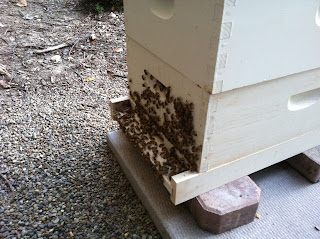
After five weeks away, I returned to my Ohio home Saturday about 5PM. As soon as the dog had been turned loose, the cat freed from her carrier/prison and the torts were released from their cramped traveling quarters, I headed out to the hives. It was too late in the day to open up and examine the hives so I had to be content with seeing how things looked from the outside. At dusk, I revisited my tree stump perch. The bees were returning to their hives. Due to the heat, they were forming slight beards on the fronts of the boxes. The bees keep the temperature in the hive at about 90 degrees, so when they are too warm, they hang out on the front porch.

This is Hive 3 at sundown.


Sitting on the front stoops, waiting for dark.


I stayed out there until it was almost completely dark. The decreasing light made the meadow look even more lush, the cicadas were singing, the house wrens were scolding me for coming too close, the hives were humming and maybe best of all, the fireflies were flashing their messages across the meadow and deep in the ravine.

Sunday morning, while it was still only in the 80s, I was ready to examine the hives. Right before I donned my bee clothes, took a precautionary Benadryl, grabbed my tools and smoker and got down to business, the meadow had a visit from a doe and her two spotted fawns. We admired them all and allowed them to munch on some meadow greenery before letting Sam out to chase them off.

Hives 2 and 3 are making similar progress with drawn out comb. While Hive 3 is one box taller than Hive 2, not much is going on up there. There were some bees in that super but little comb, no eggs, brood, larvae, pollen or honey. The next box down had frames heavy with honey. I continued to examine frames in the next box down (2nd from the bottom), where I saw lots of capped brood and larvae. I didn't find the queen but since the girls were getting jittery (one went into attack mode on Harvey's arm) I decided not to examine the bottom hive box.

Hive 2 had less honey but the frames looked perfect with brood and I could see that comb where bees had emerged was prepared for another visit from their Ohio queen. I found her in the middle box so I closed it all up without delay.

Hive 1 is still the strongest of the three hives. Her majesty has been busy running a great hive. I got to see her, too! The inner lid of Hive 1 was so loaded with bees, perhaps 1,000 of them, I knew there would be many accidentally crushed when I reassembled the hive so I shook them off in front of the hive. After the hive was safely closed, I went to the front of the hive and got to see all those bees marching in a wave back to their front door. What remarkable little creatures they are.

Sting count remains at 9.