Thursday, June 14, 2012

Too Many To Count

Too many to count!  Bees?  Well, yes, but I am actually referring to the flowers in the meadow.


The meadow is still growing.  In places it is now chest high, almost five feet.  The tickseed (coreopsis) has been blooming for a while, giving us scattered blossoms of yellow. I have been watching the buds, hundreds if not thousands, forming on the rudbeckia (black-eyed Susan), and waiting and WAITING for them to open.  The waiting is over and the meadow is now a sea of yellow daisy-like blooms. I thought the bees would be square dancing about all the flowers, but when I looked at the meadow up close, I saw wasps, yellow jackets, a new kind of dragonfly, butterflies, smaller pollinators and daddy longlegs, but no honeybees.

At the OSU beeyard last night, I asked if bees are attracted to black-eyed Susans and was told that bees don't like them.  Well, this is a real missed opportunity! I am delighted to report that when I walked around the meadow this evening, there were plenty of bees in the yellow flowers.  I did not see full pollen baskets so I am assuming they are after nectar.  The misinformation at the beeyard brings home the point that if you ask a question of two beekeepers, you will get three answers of varying accuracy.

From the house, the hives have almost disappeared from view.  In the photo, you can easily see hives 2 and 4 and just a glimpse of hive 3.  Hive 1 is still there, I promise.  In "Oklahoma!" the corn was as high as an elephant's eye, but in my beeyard, the meadow is as high as a deer's eye. This afternoon, I saw movement out there by the hives. I waited and watched and saw a pair of deer ears, just the ears, moving across the tops of the flowers. The meadow plays tricks on my eyes. First, I thought the deer was on the path between the hives and the meadow. Then it looked like the ears were surrounded by meadow. Quite possibly, the deer was in the thick of it.

Parts of the meadow are falling over.  It might be due to collapsing under the weight of the thick plants, but it might also be that deer are bedding down in the meadow.  In either case, I am confident these are natural occurrences.  The falling down plants are still thick and blooming heavily.  This is NOT a tidy garden. In this photo you can see the unevenness of the plants.


The iPhone camera is not the best for closeup photography, but look closely and you'll see the honeybee on the center flower.  That's my girl!  Actually, there's really no way to know that, but I'm claiming her anyway. Unless she stings someone.


Shifting my attention from flora to fauna, here's the latest bee news.  At the beeyard last week, I was encouraged to take honey again before I head south for the summer.  Susan and I are now partners in an extractor.  We will now be able to take honey without having the bees devour it while we wait for our turn to borrow the bee club's extractor.  Harvey and I got the garage all set up yesterday and I headed out in the cool of the morning for a solo harvest.  I started with Hive 4, my strongest hive.  At the first harvest I saw that the queen had been all the way up in the top box.  There was capped brood up in the honey super.  Last week when I checked, the bees had emerged and the cells were filled again with honey. Yesterday, I saw that the queen had been up there again.  There was one nice frame of capped honey, some frames with capped brood and mostly frames filled with nectar.  Uncapped honey should not be harvested because it has too high a percentage of water.  The bees know when it is right and that's when they seal the cells.  I trust the bees to seal it when it is ready and that's when I will harvest.  I pulled the frame that was ready and went on to the next hive.

Hive 3 is the weakest hive.  I found lots of capped brood, plenty of stored nectar, and I decided to give these girls a boost with a frame of capped brood from another, better populated hive.  When I opened Hive 2, I switched two frames with Hive 3, only to realize when I continued my search for honey in Hive 2 that something is not quite right in there.  There was plenty of honey (one frame capped, so I pulled it), mostly uncapped, lots of capped brood, but almost no larvae.  I have to wonder if the queen I waited so long for has gone missing and if the hive is queenless once again.  Hive 2 could not afford to give up frames, so I decided to take two frames from Hive 1.  Musical chairs, bee style.  

Hive 1, the swarm hive, is going very well but there was no honey for me to take. It wouldn't pay to harvest just the two frames of capped honey--too much clean up time for six jars. There would be no harvest on this day. In the future, I need to make better mental notes about which boxes have frames out.  I had to open all the hives again because I didn't remember which boxes were incomplete. I can do better with this.

One very neat thing is, for the first time, I got to see bees emerging from their capped cells. I wish I could take photographs when I'm in the hives, but the iPhone would never be the same from my propolis-sticky fingers.   There is a solid pattern of tan capped cells where the bees are growing.  When she is ready to emerge, she chews a ring out of her cell cap.  What I saw was her beady eyes and antennae poking through the hole, and then her head.  I had too much to take care of to sit and watch bees emerge and didn't want to run the risk of agitating the bees by keeping their hives open too long. So, I moved on.

I am already noodling new ideas for improving my harvesting logistics.  If the weather holds out, I will try to harvest on Saturday, my last chance before I head south until August.  

I got through all those hive boxes with no stings.  However, when I inspected last week I did get the teensiest, least little sting through my glove on my right index finger.  It was less annoying than a mosquito bite.  I hope my luck continues to hold out.

STING COUNT
2012  4
2011  13


Tuesday, May 29, 2012

How Sweet It Is!


Two postings have been in my head that never made it to cyberspace, and today deserves a posting, too, so I'm going to get all out of order and give you the latest news first.

A's Bees is proud to announce the first Worthington harvest. The meadow hives are now in their second season and I expected to be able to take a spring harvest. That usually happens in June, after the early nectar flows from honeysuckle (the damn stuff is good for something!) and the honey locust trees. Like everything else this spring, the honey came early.

When I was looking in my hives Wednesday of last week, Hive 4 had an entire super filled with capped honey. There was good progress in the other hives, too, so I asked to be put on the list to borrow the bee club's extractor. It became available to me late yesterday, so I prepared to make a Memorial Day morning harvest.

My dear husband helped me collect the pieces and parts I would need in the morning. He had an early bicycle ride planned so after cleaning the extractor, we began staging the garage/honey house and planning my strategy. Harvey strapped the extractor to the pillar in the garage that holds up the house. He used his compressor to blow out all the cottonwood fluff and maple tree helicopters that have been accumulating in the garage. He found a disposable drop cloth (very smart move, H.), dragged out a trash can and fashioned a work surface on top of it, readied the harvesting buckets with and without honey gates (taps), filled a bucket with water to deal with sticky hands, cleaned the electric hot knife (old, but new to me) and laid out the cappings scratcher. I decided to use a cardboard nuc box to carry frames from the hives to the garage.

Friend and fellow beekeeper, Susan, wanted to be here, not to help, but to watch. Uh huh, right. She arrived about 8:30AM and we headed to the meadow.  Last fall, after seeing my supers full of capped honey, I was disappointed on harvest day to find that the bees had eaten it all. When I opened Hive 4 and removed the Ross rounds (full of lazy bees who STILL had not built any comb) I pulled out the first frame of honey from the honey super. Not only did my bees eat their stored honey (again!), I discovered that the queen had been way up in that box (far from the bottom two boxes where she is supposed to stay) and laid eggs in the honey super. Four of the frames had large sections of capped brood. While this means more bees for the colony, it is not good for the harvest. I couldn't take those frames to be extracted.

Bees are protective of their honey and their brood.  When honey is harvested, the beekeeper needs to work fast, but calmly, to take frames, brushed and shaken free of bees, to a bee tight space. If they figure out they are being robbed, well, you know what happens to the beekeeper. This is where Susan was really helpful. As soon as I got the frame free of bees, she opened the lid to the nuc and closed it immediately after the frame was inside.  Honey frames in, bees out. The extractor takes 3 frames of honey at a time, so I took only 3 frames from the beeyard.

In the closed garage, I shed my jacket and hood and we got to work with the hot knife, cutting the cappings off the honeycomb.  Slicing off the cappings allows the honey to spin out of the frames when cranking the extractor.  Here I am, cranking. Please, no remarks about being cranky.


These are honey-laden cappings.  To the right is the tip of the electric knife.  The cappings, once drained and clean of stickiness, will go to daughter Ivy for Bzz Balm.


I took the empty, but still sticky frames back to the hive.  The bees will clean out all the remaining honey in the comb and move it down deeper in the hive to store for future meals. Since the bees in Hive 4 were so unhappy with the Ross rounds, I moved that equipment to Hive 1.  Swarm bees are supposed to be less picky so I'm going to give them a chance to make comb honey. I took two honey filled frames from Hive 2 and 1 more from Hive 4 for extraction. There was plenty more honey in Hive 2 but I wanted to leave it to feed the growing colony.

Honey flows out the extractor, passes through a double sieve and collects in the honey bucket. A full bucket holds 60 pounds of honey.


My collection bucket also has a honey gate which I open to fill the 1 pound jars. Here you see the first filled bottles.  When I finished extracting, the honey filled the collection bucket to the handle grip.


Here are 18 jars from my first harvest. The cappings gave me another 2 pounds of honey.  Leftover dribbles went into my honey dipping jar.  Altogether, I wrung out 20 pounds of honey from  6 medium frames, a fine yield.


The honey is very pale yellow and has a light, delicate flavor. Harvey did some googling and learned that very light colored honey is highly prized.  The picture below is of a bottle of my honeys.  The darker honey at the bottom was harvested from my Madison County hive last fall.  The jar is topped off with honey from today's harvest.  I call this my Humboldt Fog jar of honey.  That's cute, but it really shows how honey differs from season to season and by geography.  Honey characteristics are all about where the bees found the nectar.  If I had waited to harvest in late summer, this honey would have been mixed with honey the bees will make later in the season--darker in color and stronger in flavor.


A big concern of which my faithful readers are unaware is that Hives 2 and 3, my other two nuc hives, have been queenless. When I inspected the hives two weeks ago I found lots of bees, lots of honey but absolutely no brood in either hive. It looked like a ghost town on Gunsmoke. Something was very wrong and the queens were gone! It is possible that I crushed them the last time I inspected (not likely times 2) or that the hives had swarmed but none of the clues allowed me to know for sure. What I did know for sure is that Hive 3 had 8 queen cells and Hive 2 had 15. The workers knew that their queens were gone so they started feeding royal jelly to bee eggs to create new queens. Each colony nurtures its queen cells until a queen emerges. She kills the other developing queens (queens do NOT share the throne), takes a mating flight when multiple drones have to find her and mate, thereby making the ultimate sacrifice for the good of the colony and she needs to return safely fertilized for life without getting eaten by a bird en route to her hive.  So many things can go awry! Today, I looked closely and, once again, I saw larvae. Hives 2 and 3 are back in business! The colonies are queenright. With the collective wisdom of the colony, they fixed their own problem.

Last Wednesday, when I was hoping to find brood in my struggling hives, I grabbed a hive body and planted my hand right on a bee.  I got a tiny sting through my right goatskin glove, in the fleshy part between the thumb and forefinger.  No big deal, except for the bee.  I always say I don't make the same mistake twice, but that afternoon I did.  A few minutes later I reached for another hive body and squished a bee under my gloved thumb.  I have no one but myself to blame for my stings. I was careless, twice.  No stingers, and preventative Benedryl was already in my system so I had a mild reaction of just a little swelling in the tip of my thumb.   I made it through the harvest with no mishaps.

STING COUNT:
2012  3
2011  13

Thursday, May 10, 2012

They Moved In!

The beeyard at 10am on a cool spring morning is not a happening place.  I had no idea if the girls had stayed put last night.  If they had found the new hive unacceptable they would have swarmed again and headed off for something more to their liking, like a cardboard box. There were still bees hanging out on and in the carton, around the exposed frames and there was a cluster of them on the tree trunk closest to the hive.  Were they swarming up again?  There were some dead bees on the ground and on the landing pad.  Casualties are expected.  There were no bees coming or going in the new hive, but there were none coming and going in the other hives, either.  It was still too cool.  Since I was not dressed appropriately for encounters of the bee kind, I went back into the house.

I spent a couple of hours planting and sneaking looks at the hives.  Now there were take-offs and landings, a good sign.  The bees were still clustered on the tree.  Late this afternoon, I was ready to suit up and check on the first three hives.  I had bought some special equipment to make comb honey and would have installed it yesterday had I not gotten sidetracked by the swarm.  I meant to take a picture of the Ross rounds before I installed the box but my head was full of bees and I forgot.

Comb honey can be produced a number of ways.  The foundation we use is made of beeswax stamped into the familiar hex shape of the cells.  Wire is embedded in the wax for support.  Have you ever seen honeycomb for sale with wire in it? Me, neither.  When we want to cut the honeycomb we use foundation without wire. The comb can then be cut and plunked into a wide mouth jar.  Or it can be cut out of the frame with a big square cookie cutter-like gizmo and then the sticky squares are dropped into clear square boxes.

Honeycomb is quite fragile.  When I accidentally mash it with my hive tool, the honey oozes out.  The idea of using a square cutter sounds like a big sticky mess to me.  Ross rounds are shallow frames that fit into a shallow wooden box which sits on top of the honey super, but below the inner and telescoping covers.   The two halves of the frames each have plastic inner frames with four circular openings. Rings fit into the circles, wax foundation goes between the halves and then the halves are snapped together.  The wooden box holds seven of these frames.  The bees, programmed to build comb and store honey, have nowhere else to do it so they build comb right inside the rounds.  Then they fill it with honey.  I will have to monitor their progress and as they fill the rounds, I will remove them and snap clear plastic tops and bottoms around their fine work.  Voila!  Comb honey!  Do the math!  If the honeybees do their jobs, each time I set up the works I will have 28 containers of round comb honey.  In reality, I will remove the frames as they are filled and replace full rounds with empty ones.  At some point in the summer, I will remove the equipment so the bees can continue to store the honey they will need for themselves.

How I wish I had taken photographs of the Ross rounds.

At 4:30 this afternoon, I suited up and smoked what used to be Hive 2 and is now Hive 3.  I have decided to take less invasive care of the hives this year.  Instead of taking out each frame, looking for the queen, looking for brood, looking for those tiny eggs I can NEVER seem to see and working my way to the bottom of the hive, most of the time I intend to check out what's going on in the top box.  I need to see if honey is filling the frames, and if so, I'll put on another super.  I am going to trust the bees to do their thing.  And the less time I have the hives open, the less I will upset the bees and hopefully, this will result in fewer stings.  Please!  There were bees in the upper box and the cells were glistening with honey, but they had not capped the cells.  This hive was not ready for another super.

Hive 4, (previously 3, where the cranky bees lived last year) was loaded with honey, much of it capped.  I made the decision to put the Ross rounds on this hive.

In Hive 2 (previously 1), I found frames heavy with capped honey.  Most of the frames were full.  This hive needed a honey super.

I really wanted to take a peek under the cover of the swarm hive.  First I moved all the empty frames away from the hives.  Then I checked the cardboard boxes for live bees.  There were none, so I moved them away, too.


This is the inside flap of the box the swarm had made home.  The white squiggles are beeswax where the burr comb had been attached.  Here's a close up.


Yesterday, I guessed there were 6-8 pieces of burr comb, but this shows 10 good sized pieces and the dots are where the bees had begun to build two more until I intervened.  I love how the wax is so carefully spaced.  The remains look like fern or fish fossils.  Imagine this flap of cardboard turned back inside the box, horizontal to the ground.  Each squiggle had oval shaped, fully formed wax honeycomb suspended inside the box.  Row after row.  If left alone, the bees would have filled the entire box with these structures, the queen would have laid eggs and the whole thing would have functioned exactly like our modern box hives. Modern? The design we use today is called a Langstroth hive and it was patented in 1852.  It is an improvement on previous designs (including wild hives) because the frames of honeycomb are moveable to allow a beekeeper to work with the hive and to collect honey without destroying the hive.

When I opened the swarm hive, now known as Hive 1, the upper box was loaded with bees.  I pulled a few of the frames and could see into the bottom box where the burr comb remains, for now.  I have no idea how many bees were hanging out in the bottom box and I didn't want to disturb the girls any more than necessary, so I didn't open up the whole hive.  The frames in the top hive already had some honey.  If the queen is in there, she would already be laying eggs, but these old eyes can't quite see them, so I didn't waste time looking.  Since I will be away for a few days, I decided to add a box to this hive, too.  When I return next week, I'll take the hive down to the bottom and replace the burr comb with frames.

I came back to the house to take two boxes with frames from the basement to the beeyard for Hives 1 and 2.  The frames for Hive 2 already have drawn comb from last year.  The frames for the swarm hive have new frames with foundation without comb.  I was told that bees that have swarmed produce comb quickly and I figured these girls need to be kept busy.


This is what the beeyard looks like now.  That's the swarm hive on the left.

STING COUNT:
2012   1
2011   13

I'm a Beekeeper: The Real Deal

Today, I feel like a genuine beekeeper.  I captured my first swarm and set up the newbees next to my other hives.  Here's how it happened.

I was working the hotline for the Ohio Wildlife Center this morning when I picked up a message from someone who had a swarm in his yard.  I called him and he told me bees swarmed into his yard this past Friday and had moved into a cardboard box on his porch.  He had been unsuccessful at finding a beekeeper to collect them and he tried our hotline.  It was his lucky day!  Mine, too!

Bees swarm when they are crowded in their hives.  They fly around in a big mass and land someplace with their queen while scout bees look for a suitable new home.  Murphy is often hard at work when it comes to where swarms land while awaiting their new digs.  We find bees in walls, cascading over eaves, WAY high up in trees, in barbecue grills, under the hoods of cars.  The lucky beekeeper has to figure out how to capture the swarm from frequently precarious locations.  That the hotline volunteer is a beekeeper, that she was taking calls NOT on her regular day and that a swarm would MOVE INTO A CARDBOARD BOX is a perfect storm of great bee karma.  I scrambled to make arrangements to get this swarm.

I have lots of empty hive boxes and frames to go in them but I was missing a few important pieces: screened bottom board, inside cover and telescoping cover.  I called my mentor, John, from whom I had bought my nucs.  After he recovered from the stunning news of the whereabouts of these bees (really, the only swarm easier to catch would be one that moved into an abandoned hive) he kindly offered me some loaner equipment.  I was in business!  I raced to Plain City, picked up the pieces and parts and staged them in my meadow.  My landscape architect was coming to work on the steps into the ravine so I asked him sweetly to level a cement paver for a new hive.  Thank you, Bud!

Several hours of unexpected beekeeping really didn't fit well into my plans today. Swarms happen often in the spring, but they don't care about anyone's schedule. I decided to wait until evening to go for the bees, which were on the west side of town. By waiting, the scout bees would be home and fewer bees would be left behind as doomed, homeless, lost souls.

I packed my car with my bee suit, boots, smoker, tools, tape and a spray bottle of sugar water with Honey B Healthy, a deliciously fragrant minty liquid that, when sprayed on bees, calms them and renders them drunk with happiness as they groom the sticky stuff off of each other.  I found my way to the west side address and took a look at the situation.


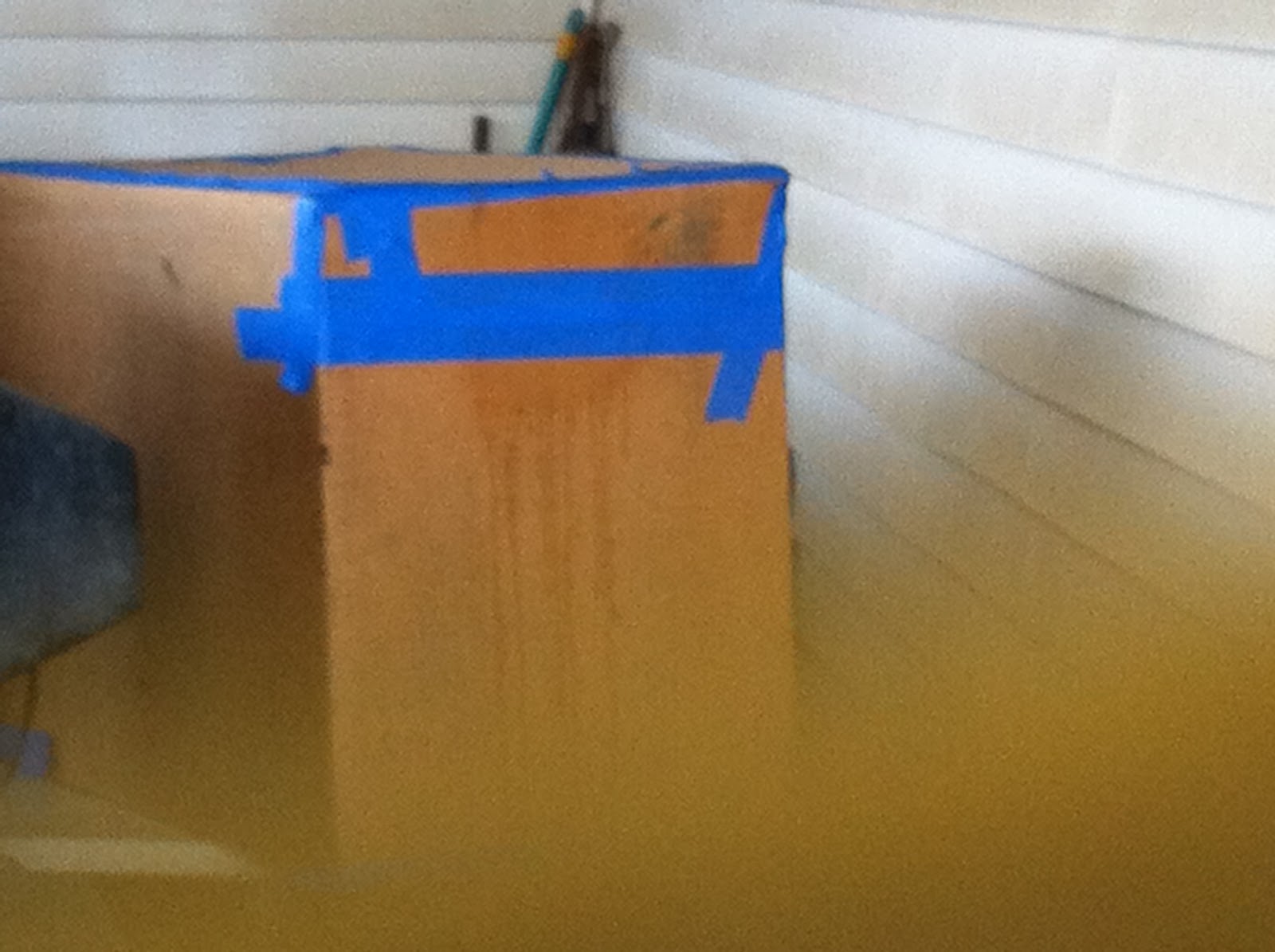
The brown box is where the bees are.  That's a roll of carpet on top.  I needed to get that carpet off the box without upsetting the box (and thousands of bees).  The homeowner was keeping a healthy distance and I knew I'd have to wrestle with the carpet by myself.  Bees were flying all over the place.  I suited up and took a closer look.  The box had a four inch slotted opening, a hand hold, that the bees were using as their entry.  These are some smart bees!  The scouts had found a new home that couldn't have been more like a traditional hive box.  I made my plan, very carefully slid the rug off the box and sprayed joy juice into the hand hold/front door.  I slid the box onto the table in the forefront and found the back door on the opposite side.  Out came the masking tape.


The tape is covering the slot and drips from the sweet spray are staining the cardboard.  I taped and taped. Then I taped some more. And I turned the box and continued to tape until every opening and flap was safely sealed.  Then I gingerly slid the box so I could peek underneath to see if the bottom was secure, or even if there was a bottom!  There was.

Did I mention that it had started to rain?

This box is bigger than it looks, a good three feet long, and it wouldn't fit in my trunk.  I was glad I had used generous amounts of tape because that box would have to travel in the car with me.  The drive home was, thank you God, uneventful. As I drove home I could see clear skies and decided to shake the bees into their new digs tonight rather than wait until morning.  A quick phone call to my mentor helped me decide how to move the bees out of cardboard and into wood.


Since the bees had been in their cardboard hive since Friday, I expected to find burr comb.  Bees hate empty spaces and fill them with beautiful white come.  The plan was to take frames out of the bottom brood box and transfer any comb I found in the cardboard box into the hive body.  I sawed into the top of the box and met resistance.  Was there that much comb?  I cut a long flap in the top and pried it open, spraying sugary liquid on the bees.  Inside...more cardboard.  The box was double boxed.  Inside were two more boxes.  More cutting, more prying and the work inside the hive was revealed.  There were 6-8 exquisite ovals of white wax, all larger than my hand, attached to the inside top of the box in perfect parallels, like multiple sets of curtains in a theater.  I slipped the comb into the empty space in the hive body and started shaking bees into the same cavity.  I wish I had photos of the comb before I scraped it out.  This was not a good time to be a photographer.

There was a whole lot of shaking going on.  I kept spraying sweets to keep the girls on their happy sugar high. I shook bees out of both inner boxes and I shook bees out of the larger box where they had reconvened. There were lots of bees on the ground.  I had no way to know where the queen was and can only hope I didn't crush her and that I shook her into the wooden box.

Bees were zooming everywhere by now.  I felt that familiar sharp pain on the middle bone of the middle finger of my right hand.  Stung, right through my leather glove.


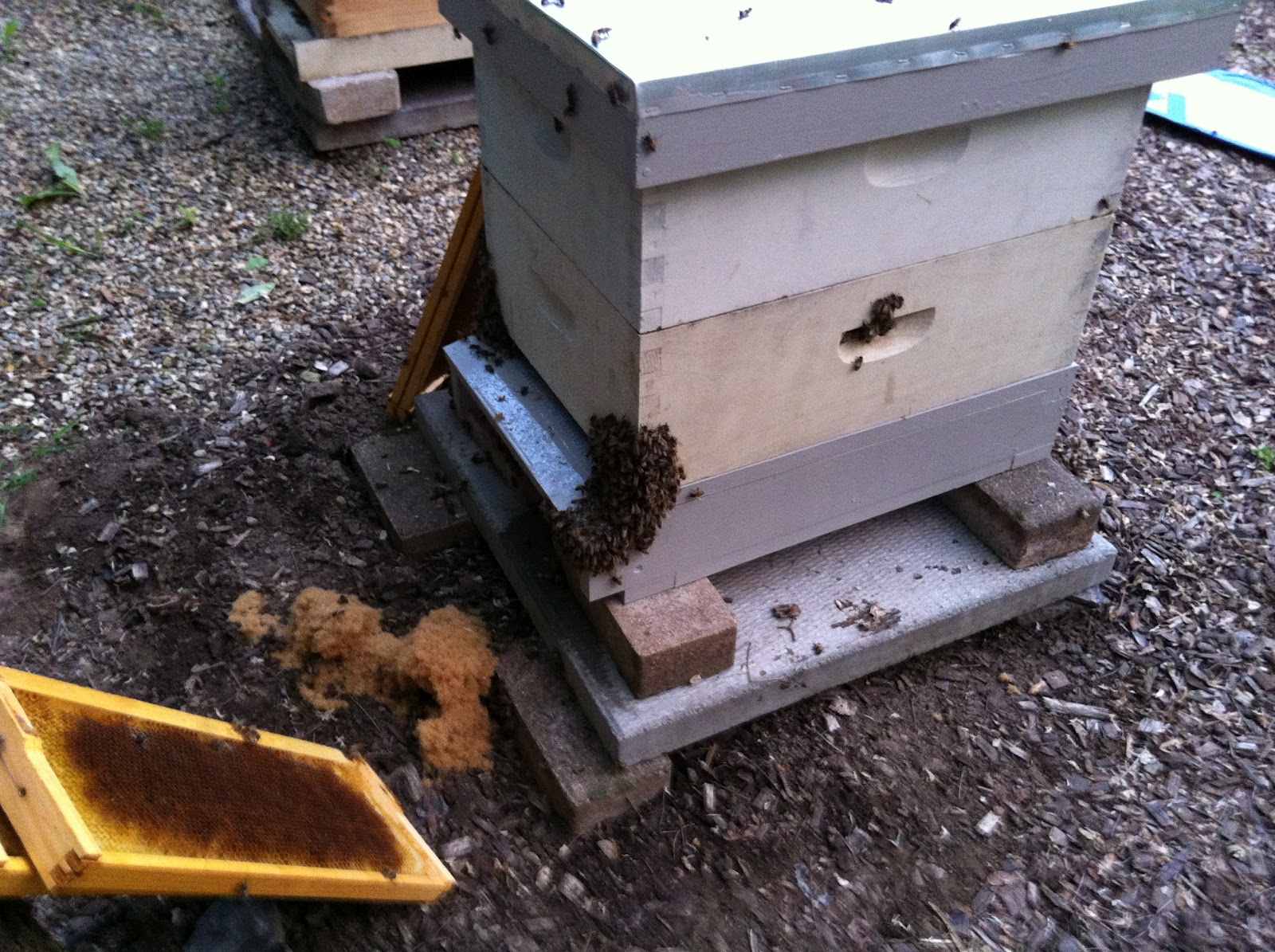
The bees were bearding on the front of the new hive.  The bees on the ground are not apparent, but they are there.  I left the extra frames and the cut up carton out by the hive.  The smell of their own burr comb would lure the bees inside, even the queen if she happened to fall to the ground.  In the morning I will gather up the cardboard and the unused frames and hope for the best.  I will see if bees are coming and going to their new hive but I won't open it until next week.  If the queen survived the move, I will see brood.  If there is no brood, I will requeen the hive.

STING COUNT
2012  1 (teeny tiny, no stinger, inconsequential)
2011  13

Friday, May 4, 2012

Bees, Water and the Homeless

Things keep happening around here that are bloggable, but the words refuse to write themselves.  So, in chronological order, here's what's been going on in the beeyard.

PART 1: THE HIVES

I thought I was so clever when I bought my hives last year. I bought all medium depth equipment so everything would be interchangeable.  That was great planning until I decided to repopulate my hives with nucs.  The nucs have half the number of frames, but the frames are deep.  My nuc mentor crafted extensions to accommodate the deep frames but the nucs had 5 frames and my boxes hold 8. Hive boxes are like kitchen cabinets and closets--there's no such thing as empty space.  Bees don't like empty space and when they encounter it they make burr comb (irregularly shaped comb) or they produce drone comb and raise the brood to become drones (fairly useless males) instead of workers (the females that do all the work in the hive).  Hmmm.  So before I even picked up the nucs I ordered deep boxes and some deep frames to complete them.  This was a good idea, but the boxes didn't arrive in time for moving day. Two weeks ago I opened my hives in order to install the deep hive bodies on the bottoms of the stacks.   

When I suited up, the landscaper working in the yard told me he had seen a big bee.  I thought he meant he had seen a carpenter bee which is, indeed, a really big bee, but he told me no, he had seen a swarm 30 minutes earlier and they settled into one of the new junipers at the edge of the meadow.  And then they headed north.  I wandered next door to see if I could find them, but they were gone.  Now I was worried because I jumped to the conclusion they could have been my bees swarming.  I decided to pull out 3 mediums from storage to stack on each hive.

I really wanted to get in, move the furniture and get out so I didn't take the time to look for the queen (I've not seen her even once and suspect she is not marked) and satisfied myself with a mini visual examination.  I saw lots of brood, plenty of multi-colored stored pollen and lots of bees.   Crowded bees swarm. My bees had plenty of room.  The swarm was not from one of my hives.  Later, I did some mental math and realized it couldn't have been my swarm because my bees hadn't been in the hive long enough to make a new queen.


PART 2: THE SPA

This is our new pond.  At the time I took this photo, it had been trickling in our back yard for about a week.  The water was finally clear and the first of our plants had been tucked into the stones.  There are 6 goldfish in there, but they are hiding. Just to the left of the waterfall, notice the flat rock that is half wet.


Last year, the bees took a liking to this particular birdbath and they made it their spa.


This is a closeup of that previously mentioned rock.  See the girls?  We THOUGHT we were putting in a water feature for us but apparently we have installed a 1,000 gallon bee spa.  Bees need water, too.


PART 3: THE SWARM

On Tuesday I was on the back deck chatting on the phone with my friend and fellow beekeeper, Susan, when something caught my eye.  On the edge of our property, about 13-14 feet up was a swarm.  Bees don't carry ID so it's anybody's guess if this was the same swarm that had been spotted 2 weeks ago or if these were from my hives.  Bees swarm when they are crowded, particularly in the spring, and they hang out in a big cluster with their new queen while scouts look for a suitable home. Beekeepers love to find a swarm, especially when the ball of bees is nice and low and easy to capture.  Free bees!  Unfortunately, my tallest ladder is 6' and I know I have no business standing on a top rung while I try to lop off a branch with a jiggling mass of several thousand bees.  These girls were not meant to be mine.  So I called someone I knew who had also lost his colony over the winter.  He foolishly stood on the top rung and collected the bees into a box. And he got away with it without breaking his neck. And without a sting.

STING COUNT
2011  13
2012  0

Sunday, April 8, 2012

Spring: A Time of New Beginnings


On Thursday, April 5 with butterflies in my tummy, I drove to Madison County to pick up the new bees. The nucs were available to take home the previous Saturday but I was out of town. They had overwintered in southern Ohio and had been brought to my mentor in Plain City along with I don't know how many other nucs. The cardboard nucs are too confining to keep the girls inside for several days, so they had spent a few days flying about their very temporary home in suburban Plain City. Because I was coming for them Thursday, late Wednesday night they had been barricaded inside the nuc.

On this beautiful, clear spring day, I moved the nucs from the driveway into the trunk of my car. The nucs were surprisingly heavy, perhaps 10 pounds. They were full of bees or full of honey, or maybe full of bees and honey. There were a few hitchhikers on the outside of the vents so I was happy to have the nucs in my trunk and not inside my car. In addition to the circular vents there were medallions of small holes in both end panels. Bees create a lot of heat and enclosed in a box they could easily overheat. Back home in Worthington, when I opened the trunk I found the nuc on the right had more bees outside than the hitchhikers that were there when I closed the trunk in Madison County. I watched as the bees squeezed out of the holes in the cardboard. I could see that the holes were too small for the bees to escape but apparently the bees thought otherwise and I was amazed to see bee after bee emerge from the box. I decided to deal with that nuc last.

Now that my husband's office is five minutes from home, I talked him into coming home to help me with the logistics. I needed to move three nucs, each containing 5 deep frames, thousands of worker bees and a queen into my waiting 8-frame medium hives. Working through the logistics reminded me of one of those brain teasers about moving foxes, hens and corn across a river in a canoe in such a way that the foxes wouldn't each the hens and the hens wouldn't eat the corn.

A little background. When I bought my hives last year I decided to use all 8-frame medium hive boxes. Hive boxes come as shallows, mediums or deeps and hold eight or 10 frames. A deep hive box filled with bees and honey can weigh more than 50 pounds. Show me even one beekeeper who doesn't have a bad back! Schlepping 35 pound hive boxes seemed like a much better idea. BUT, the nucs' frames are deep so I knew they wouldn't fit in my medium boxes. My mentor made me wooden spacers to lift the bottom brood boxes so the deep frames would fit. I would fill out the box with my medium frames. I know that bees don't like empty spaces, so I expected they would fill the gaps with drone comb or other weird wax configurations. The beauty of having all mediums or all deeps is that all the equipment, including frames, is interchangeable. So much for that idea. At the last minute, I ordered deep hive boxes for my brood boxes, but they hadn't yet arrived. I needed to go with what I had.

My three hives were still as I had left them last fall. Two colonies were four boxes tall and one was three boxes tall. At the end of the installation, I would need each hive to be comprised of (starting from the bottom) a bottom screen, a wooden spacer, two hive boxes, an inner cover and a telescoping cover. I had to make room in the bottom boxes for the fully loaded frames from the nucs. I had more frames than I had boxes to put them and more boxes than I needed, for now. And I had three nucs full of bees that had been on lockdown for 15 hours. Let's call them potentially unhappy bees.

We staged everything, I was already suited up and I stoked my new electric smoker (thank you Harvey for a beekeeper's best present). I carried the first nuc of bees to Hive 3, former home of the cranky girls. The frames were all drawn out and full of brood and honey. And there were bees everywhere. I didn't take the time to look for eggs nor to try to find the queen. I just wanted to get those frames safely transferred! After moving the nuc frames there were plenty of bees still in the box so I shook it over the frames and prayed that the queen was in the hive box and that I hadn't accidentally crushed her. I stacked the next hive body, put on the two covers, left the open nuc in front of the hive for the lingerers and headed back across the meadow to my garage for the next nuc.

More escapees from the nuc on the right! I selected the nuc from the middle. The transfer went much the same. Harvey was watching from a distance since he was in banker's clothes and headed back to the office. He mentioned that I had a lot of bees on my suit.

Back in the garage, I studied the nuc with bees inside and out and tried to figure out how to lift it out of my trunk without crushing any bees and without holding any bees close to my body. The protective clothing is heavy twill, not kevlar. Now on my own, I opened the last nuc. These girls were making it very clear that they were mad as, well, hornets, that they had been closed up in that box for so long. I paid close attention to what I was doing and moved the last of the frames into Hive 1.

Back in the garage, a good number of bees (100+) had decided that my trunk felt like home. Every time I tried to sweep them out they flew back in. I left the trunk open and the garage doors open and hoped they'd figure out where their queen went.

I love my bees and am fascinated with them but I still find working with them to be stressful. If I didn't get those nasty reactions to the stings, I would probably be more relaxed. By the time I am finished doing whatever I need to do with all those flying stingers, I'm sweaty and pretty wiped out. Still in my bee suit, I tromped into the kitchen. That's when I heard the buzzing sound that meant I had a bee on my hood.

Beekeeping with a partner has its advantages. The advantage of the moment would have been for me to do a slow pirouette while someone else tells me if I have any bees on my suit BEFORE I go into the house. A really good partner would help brush the bees away. I decided to take off my hood and jacket outside on the deck. Here's what had come into the house with me!


I figure that's a little cluster of about 50 bees. I did remove three bees from the kitchen.

The deep hive boxes arrived Friday, one damaged. I'm still working on that and have not gotten motivated to tear down the current configuration to put the girls into the deeps. Since Thursday, I have been out to the hives several times a day. The bees are flying happily about. I have seen them in the meadow, hanging out with the dandelions. They are coming back to the hives laden with white and pale yellow pollen. This is all a good four to six weeks ahead of what we had last spring.

STING COUNT:
2012 0
2011 13


Friday, April 6, 2012

What Happened this Winter

One might think that a mild winter would be easy on the bees. One would be wrong. Bees are actually programmed to survive the cold. When the temperature drops, the queen stops laying eggs and the bees gather together in a cluster. They shiver their wings and take turns being in the warmest part of the cluster. Enter the mildest Ohio winter anyone can remember.

When the temperature gets above 40, the bees come out of their cluster and take cleansing flights (NO POOPING IN THE HIVE!!). In January, we had some 60 degree days. In February, too. We all know the trees and flowers were confused with the springlike winter and so were the bees. They broke out of their clusters. The queens starting laying eggs two months earlier than they were supposed to. The workers were beginning to care for the brood and when the temperatures dropped to the 30s, they were not in their clusters. They got too cold and they died. Well, most of them died, and more importantly, the queens died.

On Feburary 20, after a couple of glorious 60 degree days, I opened up my hives. I had been seeing bees flying about so I expected to see bees in the hive. In each hive I found puny little clusters the size of a large egg. A healthy cluster is the size of a basketball. A week later I looked again and found two out of three of my queens, dead. There were still bees flying about. They might have been my own bees who had not yet died of old age or they might have been someone else's bees robbing the honey still stored in the combs. I felt SO sad. I was sure at least one hive (the one with the cranky bees) would make it.

The same scene played out all over central Ohio. The seasoned beekeepers are quite matter of fact about dead colonies. This is agriculture; they are not pets. They spend no time mourning, but look intellectually at what went wrong. Easy for them.

I know I had strong colonies going into the winter. I know they did not starve as there was ample honey stored in each hive. They were fed, sugared, insulated. I can't control the variables any more than that. I can't control the weather. And I have no idea if my Madison County bees survived.

I can, and did, order new bees. This time instead of ordering packages of Italian bees with Italian queens, I ordered three nucs. A nuc is a mini beehive. Instead of 8 or 10 frames it has 5. There are lots of reasons beekeepers create nucs and perhaps I'll cover them in a future post, but these nucs were created by one of my mentors. The queens are from the best stock of a line of Ohio queens and the nucs were created while the queens were still laying last summer. These Ohio queens in their mini hives with their genetic daughters overwintered beautifully. Last April 20, I installed three packages of bees. Yesterday, April 5, I picked up my nucs and installed them in my ghost town hive boxes. Tune in tomorrow and I'll tell you how that went.

Here's a hint: 2012 sting count, 0.